



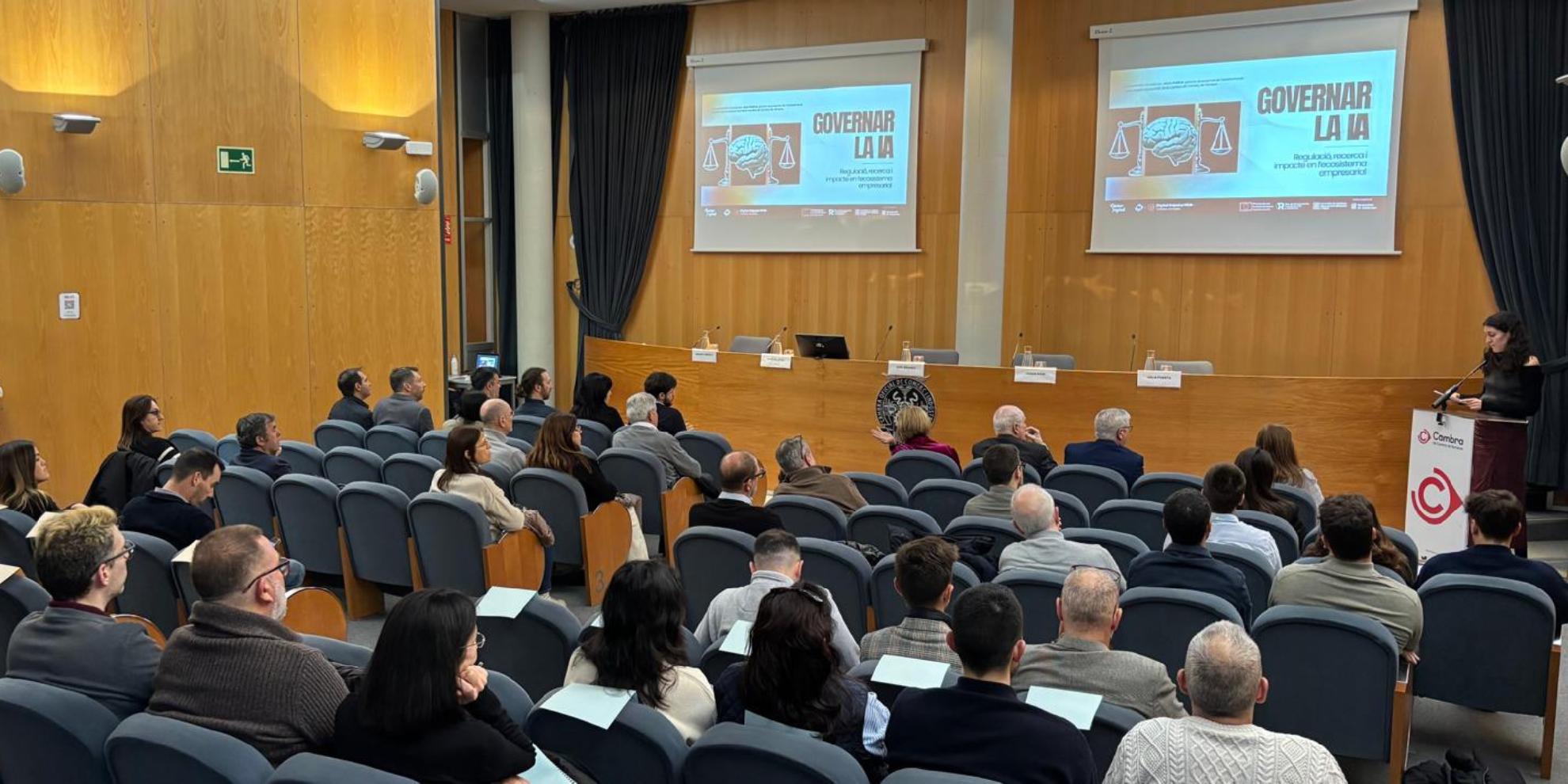
Last February 19, the Auditorium of the Chamber of Commerce of Terrassa hosted the day "Governing AI: regulation, research and impact on the business ecosystem", an event that served to put an end to two training initiatives promoted within the framework of the RETECH program: "REGULA-IA" and "Responsible Management of AI", the latter coordinated by the Digital Cluster of Catalonia.
The day brought together companies, professionals from the technology sector, institutional representatives, research groups and students, with the aim of offering a clear and practical vision of the regulatory framework of artificial intelligence and its real impact on the business ecosystem.
The "Responsible AI Management" project is an initiative promoted by the Digital Cluster of Catalonia with the collaboration of Pompeu Fabra University and the Chambers of Commerce of Terrassa, Lleida and Girona.
The program combines self-taught methodology and synchronous sessions, with the aim of training professionals from the public and private sector to integrate AI in an ethical and legally appropriate manner, apply the European Regulation on Artificial Intelligence (AI Act), identify risks and establish self-assessment mechanisms, and incorporate the perspective of gender and sustainability in technological projects.
The training, of 60 hours (equivalent to 2 ECTS credits), has been structured in five modules: Context and challenges of AI, fundamental rights and SDGs, regulation and the AI Act, tools for self-assessment and ethical management (PIO Model, fAIrLAC-BID, HAI Stanford, etc.), and practical cases and AI for the Common Good.
With this initiative, which is part of the RETECH call - Line 4, within the Recovery, Transformation and Resilience Plan (PRTR), the Digital Cluster reinforces its commitment to connect business and knowledge and turn regulation into practical action for SMEs and the country's digital talent.
The event, led by Júlia Puertas, project manager of Digital Transformation and the Digital Impulse Hub of the Terrassa Chamber of Commerce, began with the institutional welcome of Ramon Talamàs, president of the Chamber, who highlighted the collaboration with the Digital Cluster of Catalonia to offer concrete tools that help companies move forward with judgment, security and orientation towards progress.
The initial presentation was given by Meritxell Borràs, director of the Catalan Data Protection Authority, who emphasized: "The regulation should not be seen as a barrier, but as a guarantee of trust. SMEs must understand that complying with the regulations is an opportunity to compete with quality and European values."
Borràs focused on the practical implications of the AI Act and the RGPD, especially for small and medium-sized companies that develop or integrate AI systems.
The day then hosted a round table that brought together academic and business profiles to address AI governance from an interdisciplinary perspective, combining regulation, technology and applied experience. Axel Brando, leader of the TAIES group at the Barcelona Supercomputing Center, participated; Carlos López, CEO of SCALAI and member of the Digital Cluster; Manuel Portela, senior researcher at Pompeu Fabra University; and Joana Marí, responsible for strategic projects at the Catalan Data Protection Authority.
Axel Brando emphasized that "the governance of AI requires an interdisciplinary approach: technology, law and ethics must advance together, especially in high-risk contexts."
For his part, Carlos López put the business reality on the table:
"Legal uncertainty worries many SMEs. That's why we need training and judgement: understanding the AI Act is key to being able to innovate safely."
Manuel Portela emphasized the role of training and research centers:
"Universities and research centers have the responsibility to provide companies and citizens with the capabilities and tools to promote a responsible AI aligned with European values."
Finally, Joana Marí presented the pioneering Fundamental Rights Impact Assessment (ADIF) model developed by the APDCAT, as a practical tool to integrate the protection of rights from the design of AI systems.
One of the highlights of the event was the certificate award ceremony for the participants who successfully completed the “REGULA-IA” and “Responsible AI Management” programs. More than thirty participants received their diplomas, marking the successful completion of a training pathway focused on applying artificial intelligence with sound judgment, legal certainty, and ethical responsibility.
In her closing speech, Joana Barbany, president of the Digital Cluster of Catalonia, emphasized that the day symbolizes the moment we are living in: artificial intelligence is no longer a promise of the future, but a reality that is transforming the world. In this context, he emphasized the need to place people at the center of digital transformation.
Barbany congratulated the students and reaffirmed the Cluster's commitment to responsible digitization: "There is no digital transformation without ethics. If we want to compete globally, we must bet on quality and European values."
The president also highlighted the importance of public-private collaboration to strengthen the Catalan digital ecosystem and stressed that regulation must become concrete action: promote projects, generate debate and provide companies and professionals with practical tools to apply AI judiciously and responsibly.
He concluded with a clear message shared by the entire audience: "AI is not governed alone. We govern it. We continue to work together so that Catalonia is a benchmark in artificial intelligence with values."
With this first edition of the program, the territory now has twenty professionals more prepared to apply AI with knowledge, judgment and ethical commitment.
17 February 2026
The BREF Digital Packaging project continues to advance with new activities aimed at accelerating the digital transformation of the packaging and packaging sector in Catalonia.
3 February 2026
Quatre projectes col·laboratius per accelerar la transformació digital de la indústria.
2 February 2026
El projecte té l'objectiu de desenvolupar solucions innovadores per a l’automatització intel·ligent i la traçabilitat avançada en entorns industrials.


